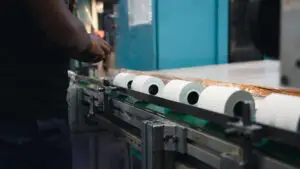
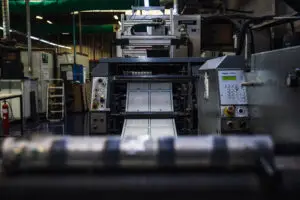
It sounds almost too good to be true: vibrant commercial print with zero water use.
No fountains. No dampening systems. No wastewater.
Just precision ink application on a press that doesn’t spill a drop. But is waterless printing the real deal or just another greenwashing buzzword?
If you work in the print industry or partner with a high-volume commercial printer like Lebone Litho, this question matters. Especially in a country like South Africa, where drought and water scarcity aren’t just headlines; they’re lived realities. So, can this technology help us build a more sustainable future for Southern Africa’s print economy?
Let’s take a closer look.
Why Water Usage in Printing is a Problem
Traditional offset printing relies heavily on water to control ink flow. This “wet” system uses dampening rollers and fountain solutions, which contain volatile organic compounds (VOCs) and require frequent disposal. Multiply this by the scale of commercial production, and you begin to see the issue.
According to the United Nations, by 2025, half the world’s population will be living in water-stressed areas. That puts immense pressure on industries, ours included, to rethink resource use.
Enter: waterless printing.
What is Waterless Printing?
Waterless printing replaces the traditional dampening system with a silicon-coated plate that repels ink in non-image areas. This allows the press to lay down ink only where needed, no water, fewer chemicals and less waste.
The result? Sharper images, tighter colour control, and significantly reduced environmental impact. It also improves energy efficiency, since press warm-up times are shorter and fewer test runs are needed.
For print facilities like Lebone Litho, servicing high-volume clients across sectors like education, government, and retail, these benefits are more than theoretical. They speak to a future where sustainability and quality are no longer at odds.
Is Waterless Printing Viable for Southern Africa?
While waterless technology has gained traction in parts of Europe and Asia, Southern Africa presents unique challenges. Cost, maintenance, climate control and supply of specialised plates and inks can slow adoption.
But the trajectory is promising.
Printers in South Africa are already investing in energy-efficient systems, closed-loop recycling and cleaner inks. At Lebone Litho, waterless printing is actively being researched for future integration, not a service offered today. We currently utilise energy-efficient systems, employ closed-loop recycling processes, and use cleaner inks in our print operations today.
As local demand for sustainable business practices grows, waterless printing could shift from “niche” to “necessary”.
Forward-looking organisations, especially 100% Black-owned innovators like Lebone Litho, are well-positioned to lead that change.
Innovation Needs Infrastructure
To make waterless printing viable at scale, it must be supported by the right ecosystem: skilled operators, reliable suppliers, and client education. The real challenge isn’t only acquiring technology, but integrating it with our wider environmental objectives.
At Lebone Litho, we’re watching this space closely. We already invest in climate-conscious practices across our litho, web-fed and digital printing divisions. Waterless may not be today’s dominant method, but it’s firmly on tomorrow’s radar.
Commit to eco-printing with waterless and commercial printing at Lebone Litho today.